A TYPE-II SUPERIONIC TRANSITION IN SILVER IODIDE
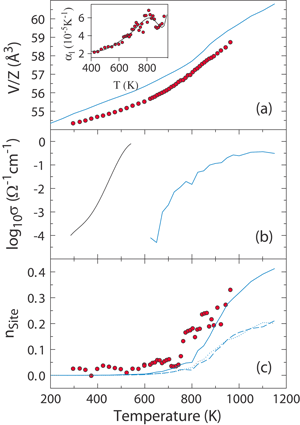
At modest pressures, AgI transforms to a rocksalt structured phase. Heating within this phase has shown an anomalous increase in ionic conductivity, which appears to become saturated just before the rocksalt phase transforms to the well-known bcc a-phase (see references to Mellander in [1]). Recent neutron and x-ray diffraction measurements and molecular dynamics (MD) simulations have shown that the observed conductivity can be accounted for by an increase in occupation of silver ions in tetrahedral interstices: the number of silver interstitials rises rapidly with temperature, before becoming saturated. This is also reflected in a small anomaly in the lattice expansion with temperature, akin to the behaviour in b-PbF2, another type-II superionic conductor. These results also have implications for the high temperature behaviour of AgBr, which also shows increases in ionic conductivity as it approaches the melting point, although AgBr melts before any saturation is observed.
Figure showing (a) volume per formula unit (b) ionic conductivity and (c) proportion of silver ions in tetrahedral interstitial sites for the high-pressure rocksalt phase of AgI as a function of temperature and at ~2.5GPa. Red points correspond to x-ray diffraction results, blue lines to MD results and black line to earlier conductivity data at 1.1GPa by Mellander (see references in [1]). The anomaly in the unit cell volume is seen more clearly in the expansivity data, shown in the inset to (a). See [1] for further details.
References.
| 1. | The nature of the superionic transition in Ag+ and Cu+ halides | D. A. Keen, S. Hull, A. C. Barnes, P. Berastegui, W. A. Crichton, P. A. Madden, M. G. Tucker and M. Wilson | Phys. Rev. B 68 (2003) 014117 |
| 2. | Pressure-induced phase transitions in AgCl, AgBr, and AgI | S. Hull and D. A. Keen | Phys. Rev. B 59 (1999) 750-61 |
| 3. | Structural evidence for a fast-ion transition in the high-pressure rocksalt phase of silver iodide | D. A. Keen, S. Hull, W. Hayes and N. J. G. Gardner | Phys. Rev. Lett.77 (1996) 4914-17 |
 |